Transcripción del discurso.
Mostrando entradas con la etiqueta chris christie. Mostrar todas las entradas
Mostrando entradas con la etiqueta chris christie. Mostrar todas las entradas
miércoles, 29 de agosto de 2012

martes, 28 de agosto de 2012
Intro de Christie
El RNC ha colgado el vídeo que esta noche servirá para introducir al Gobernador Chris Christie.
16: Chris Christie encandila a la delegación de California
El Gobernador de New Jersey habló ayer a los 341 delegados titulares y alternos de California (la delegación más numerosa de la convención) en el Hotel TradeWinds de Tampa.
Y esta mañana en Good Morning America (ABC) se ha referido su esperado discurso de esta noche.
Y esta mañana en Good Morning America (ABC) se ha referido su esperado discurso de esta noche.
Llegó Chris Christie
El Gobernador Chris Christie, de New Jersey, ya empezó a acaparar protagonismo anoche en la convención republicana con su visita al Tampa Bay Times Forum. Atendió a la prensa delante del cartel de la delegación de New Jersey y dio un discurso para la delegación de California -es habitual que los políticos con ambiciones presidenciales utilicen su estancia en la convención para entablar relación con algunas delegaciones.

(Foto: AP)

(Foto: AP)

(Foto: AP)
(Foto: AP)
(Foto: AP)
(Foto: AP)
miércoles, 18 de julio de 2012
Mitt y Chris: ¿temperamentos incompatibles?

The New York Times:
Mr. Christie’s star has faded as a potential vice-presidential pick. As polls show that his bluntness is striking more voters as bullying, Republicans close to Mr. Romney’s campaign say that the governor’s continued hostile encounters — including one on the Jersey Shore this month that was caught on video — have augmented fears that he is too unpredictable and too contentious, turning what was once viewed as a key strength into a drawback.
A decision to pass on Mr. Christie would highlight the more cautious approach Mr. Romney appears to be taking — by all indications he has been leaning toward measured personalities like Tim Pawlenty, the former Minnesota governor, or Senator Rob Portman of Ohio. This may reflect the lessons of the last presidential race, when a Republican running mate who seemed authentic and exciting went rogue.
(...) Aides and advisers to Mr. Romney, who acknowledge that he was never going to be the safest choice, privately say that they are troubled by Mr. Christie’s temper, calling it unsettling and out of step with Mr. Romney’s temperament. (Indeed, some took it as a clear sign that he will not be picked when Ann Romney said in an interview that she expected her famously button-down husband to select a running mate with the “same personality type.”)
martes, 3 de julio de 2012
Christie, dispuesto a atender una llamada de Romney

CNN:
New Jersey Gov. Chris Christie, while not saying he would definitely accept a spot on Mitt Romney's Republican presidential ticket, did say Tuesday he would give such an offer due consideration.
"I love being governor of New Jersey, you can tell. I think every day the way I do my job I love it. But the fact is, if Gov. Romney picks up the phone and calls, you have to answer the call and listen at least," Christie said on CNBC.
The outspoken New Jersey governor said he wasn't confident that he would wind up becoming Romney's pick.
"I doubt it," Christie said when asked if he thought he would be asked to join Romney's ticket.
The choice for running mate, Christie said, was Romney's decision alone.
"This is an election with one voter, Mitt Romney," Christie said of the selection process. "He gets to decide who he thinks should be the best vice president of the United States, the person best prepared to serve with him to turn this country around."
Christie continued: "I certainly am not weighing in, saying who I think it should be."
miércoles, 27 de junio de 2012
Romney y Christie, juntos


Mitt Romney y Chris Christie fueron pillados ayer saliendo por separado por la puerta de atrás del Hotel Renaissance de Woodbridge, en New Jersey. Pero tranquilos, no hay nada. Solo era una recaudación de fondos.
domingo, 17 de junio de 2012
¿La cagaste?

The most consequential vote of the political season may well have been one that occurred last October, around a dinner table in Mendham, N.J. Chris Christie had just returned home from a cross-country trip, highlighted by a speech at the Reagan Library in California, that seemed like a road test for a presidential run. When the family gathered for supper that Monday evening, Christie’s oldest son, Andrew, then 17, cut to the chase. “So, Dad,” he asked, “what’re you gonna do?”
Christie opened the matter to a family discussion, asking each of his four children and his wife, Mary Pat, whether they thought he should run for president. “It was really interesting, because none of them wanted me to run,” Christie recalls. His children and wife all said they were ready, if Christie wanted to try for it, but “none of them, around the table, wanted me to run.”
Christie himself didn’t answer Andrew’s question until after he and Mary Pat had put the kids to bed. “I don’t want to do it,” he finally told her. “It doesn’t feel right to me. If I do this, I just feel like I’d be second-guessing myself the entire time I was out there, and I can’t do it that way.”
The announcement the next day left Mitt Romney as the most viable Republican candidate, and dashed the hopes of Christiephiles everywhere. “People said, ‘Do you regret not doing this? You would have dominated this field,’” Christie says, adding that he does not necessarily agree with that assessment. “Here’s what I know about political campaigns: no matter what you map out at the beginning, it’s always different at the end.” In any case, he says, his calculation was not political but personal. Only two years into his term as governor, he didn’t feel ready for a run at the White House; it wasn’t yet his time.
Christie’s most passionate supporters, ranging from former General Electric chief Jack Welch and Home Depot founder Kenneth Langone to everyday strangers Christie met on the street, insistently disagreed. To them, Christie seemed fated for 2012, not only because his Jersey-guy bluntness promised an effective counter to President Obama’s distanced cool, but also because Christie had identified, and mastered, the defining public-policy challenge of this era—reining in the cost of government.
(...) The presidential race, being contested to an ever more obvious degree on terms that Christie defined, seemed a world away. After the Galloway event, Christie met with Newsweek, sounding like a man who might like to be asked to serve on the Romney ticket, even if he also suspects he won’t get the call. He considered the proposition that he may have missed his moment. “I don’t know, I guess only the future will tell that,” he said, insisting that he had no regrets. “If I missed my moment, I missed my moment. I mean, I wasn’t pining to be president of the United States.”Esto nos recuerda a otro caso.
sábado, 9 de junio de 2012
Vicepresidenciables en el CPAC de Chicago: Chris Christie
Varios potenciales running-mates de Romney hablaron ayer ante activistas conservadores del Medio Oeste reunidos en la Conservative Political Action Conference (CPAC).
Uno de ellos fue Chris Christie.
Video streaming by Ustream
Uno de ellos fue Chris Christie.
Video streaming by Ustream
domingo, 20 de mayo de 2012
16: Rubio, estrella en SC; a Christie le siguen preguntando
El Senador Marco Rubio, de Florida, fue ayer el invitado estelar en un evento de recaudación de fondos del Partido Republicano de Carolina del Sur, un estado con un gran peso en el proceso de primarias, como ya sabéis.
(la intervención de Rubio, a partir del minuto 15)
Esta semana volvieron a preguntarle a Chris Christie si tiene ambiciones presidenciales. Lo hizo una votante de su estado en un town hall meeting en East Hanover. El Gobernador de New Jersey, que dijo sentirse abrumado por la pregunta, respondió que "quién sabe" si se presentará algún día a Presidente, y, sin que nadie se lo pidiera, se puso a recordar sus orígenes humildes, la historia de sus padres... así que sí, se presentará.
(la intervención de Rubio, a partir del minuto 15)
Esta semana volvieron a preguntarle a Chris Christie si tiene ambiciones presidenciales. Lo hizo una votante de su estado en un town hall meeting en East Hanover. El Gobernador de New Jersey, que dijo sentirse abrumado por la pregunta, respondió que "quién sabe" si se presentará algún día a Presidente, y, sin que nadie se lo pidiera, se puso a recordar sus orígenes humildes, la historia de sus padres... así que sí, se presentará.
miércoles, 16 de mayo de 2012
16: Chris Christie se autoparodia
En un video hecho para la cena de la asociación de prensa de New Jersey.
miércoles, 22 de febrero de 2012
Christie: me lo están pidiendo pero no me presento
El Gobernador Chris Christie ha admitido en Good Morning America (ABC) que todavía están llamando a su puerta para que se presente este año a Presidente, pero ha dejado bastante claro que no va a presentarse. "No sé cuántas veces tengo que decirlo, la respuesta es no, y apoyo al Gobernador Romney."
lunes, 20 de febrero de 2012
Vuelven a llamar a la puerta de Daniels y Christie
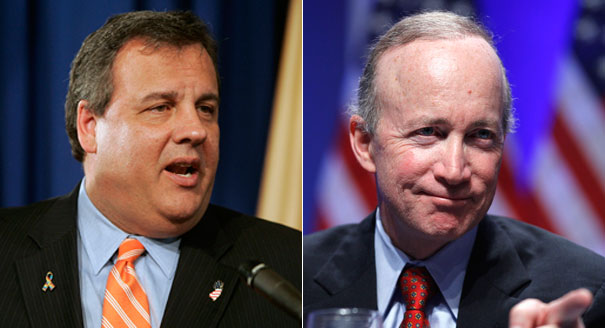
POLITICO.com:
Indiana GOP Chairman Eric Holcomb, one of Gov. Daniels’ closest advisers, revealed to POLITICO that “the whispers have become shouts, the knocks on [Daniels’] door have become fist pounding.”
“Republicans are fretting the four dancing now can’t beat Obama in the fall — so their national talent search continues,” Holcomb said, adding that the pleas had come from “the adults” in the party.
The Daniels adviser said the the Indiana governor’s State of the Union response speech prompted a spike in the chatter.
“Hand-written letters from around the country flooded in after his response to the State of the Union,” said Holcomb. “He can’t go anywhere without someone stopping him [and] asking to reconsider and present a clear vision, unify folks like he did in Indiana, and lead another comeback. Also, Indiana’s legislative session adjourns no later than March 14, [and] might adjourn earlier, thereby freeing him up a bit — and seasoned politicos know that as they game this out.”
Despite the fact that he is a top Romney surrogate, Christie, too, has received entreaties from senior Republicans, sources said, with the pitches rising again in recent weeks as Romney has struggled.
The New Jersey governor hasn’t budged from the position he took last year, when he said “no,” despite pleas coming from the likes of Nancy Reagan and Henry Kissinger. Christie also campaigned for Romney in the early states of Iowa and New Hampshire, appearing at multiple events.
And just as Christie shows no signs of changing his mind, Daniels also appears unlikely to reverse course.
“He respects those approaching him greatly, but no vote from the women’s caucus at home yet,” Holcomb quipped, alluding to the opposition against a run from the Hoosier’s wife and daughters. “[It] might take an Occupy on the Governor’s Residence lawn!”
martes, 14 de febrero de 2012
Christie no quiere oír hablar de una convención abierta

POLITICO.com:
As he dismissed speculation of a brokered convention, New Jersey Gov. Chris Christie hinted Tuesday that the Republican Party only has itself to blame for a drawn out primary process.
“The fact is, this is what the Republican Party rules set up. We decided to go from winner-take-all to proportional, and as a result, you’re going to have a much longer run here. … So the rules are working the way the rules were intended to work by the folks in the RNC. We voted against that rule, by the way, in New Jersey,” Christie told reporters at a press conference.
He added, “I think lot of people that voted for these rules are starting to have second thoughts.”
The outspoken governor was dismissive of the idea of a brokered GOP national convention, saying members of the media are discussing the unlikely possibility simply because it’s their “dream come true” scenario.
“That’s stuff that folks in the media and in political punditry like to talk about because it’s like their dream come true, that we’d actually indecision going into a convention,” he said. “It hasn’t happened to the Republican Party since Wendell Willkie. I don’t think it’s going to be happening in 2012.”
Christie, who has endorsed Mitt Romney in the GOP race, also said he is “completely confident” that by the time this year’s GOP convention in Tampa Bay, Fla., rolls around, “Romney will have secured the sufficient number of delegates to be the nominee of the party.”
lunes, 9 de enero de 2012
viernes, 30 de diciembre de 2011
Romney y Christie en West Des Moines, Iowa
Buena asistencia de público en un acto al aire libre y sin cubiertas en un día de frío, lluvia y viento en la Iowa central. Es una señal tranquilizadora para Romney, del que se dice que puede ser uno de los más perjudicados si hace mal tiempo en la noche del Caucus, por eso de que sus votantes son más pragmáticos que devotos.
El candidato ha estado acompañado por un Chris Christie que no para de hacer méritos para ser running-mate si Romney es el nominado.
El candidato ha estado acompañado por un Chris Christie que no para de hacer méritos para ser running-mate si Romney es el nominado.
martes, 13 de diciembre de 2011
Christie recauda para Romney más de 1 millón en una noche

Ya tenemos un claro front-runner para la Vicepresidencia en caso de que Romney sea el nominado.
The Star-Ledger:
Fresh from his trip to Iowa to boost GOP presidential hopeful Mitt Romney’s standing with Republican caucus voters, Gov. Chris Christie tonight helped fill the candidate’s campaign coffers.
The governor hosted Romney at a fundraiser Christie said took in $1.1 million for the former Massachusetts governor. Billed as the Romney campaign’s "New Jersey Kickoff Reception," the high-priced shin-dig at the Parsippany Hilton cost a minimum of $500 and drew more than 500 people.
Almost every Republican bigwig in the state showed up, sending the message that the New Jersey Republican establishment is in lock step behind Romney — and Christie, his highest profile surrogate on the campaign trail. The governor said all 21 county chairmen are endorsing Romney, as are 14 of 16 Republican state Senators and 27 of 33 GOP assembly members.
"Welcome to Morris County. Welcome to New Jersey. And New Jersey tonight is officially Mitt Romney country," Christie said.
Romney began his 14-minute speech by heaping praise on Christie. "This guy’s just amazing. The whole nation’s watching this guy," he said.
viernes, 9 de diciembre de 2011
Escenario para nuevos candidatos (III)

Nate Silver:
I think there is a small but nontrivial chance that the Republican nominee could be someone like Jeb Bush, Paul Ryan, Mitch Daniels, Tim Pawlenty or Chris Christie.
(...) The motive is pretty simple: Republicans are dangerously close to having none of their candidates be acceptable to both rank-and-file voters and the party establishment. It’s not quite clear what happens when this is the case; there is no particularly good precedent for it. But since finding a nominee who is broadly acceptable to different party constituencies is the foremost goal of any party during its nomination process, it seems distinctly possible that Republicans might begin to look elsewhere.
(...) Say that Mr. Gingrich survives this onslaught, as he certainly could. He wins Iowa and then either wins New Hampshire or finishes a respectable second there. He continues to lead in national polls of Republican voters, as he does now.
What happens then? One scenario, obviously — probably the most likely scenario — is that Mr. Gingrich wins South Carolina, and he wins Florida, and he holds on to win the Republican nomination.
But Mr. Gingrich might nevertheless be considered an unacceptable choice by much of the party establishment. That would put us in uncharted waters. There hasn’t really been a case in the past where a candidate who held the national polling lead after New Hampshire was considered unacceptable by the party elite. Most of the time, instead, the establishment (as measured by endorsements) and the rank-and-file (as measured by support in national polls) have agreed upon a candidate by that point in time.
There have been six cases, meanwhile, in which there was no clear front-runner after New Hampshire. These are discussed briefly below.
-----------------------------------------------------------------------
1972 Democrats. Edmund S. Muskie, the clear favorite of the party establishment, won both Iowa and New Hampshire. The performances were perceived as disappointing, however, and Mr. Muskie was at only about 20 percent in national polls (still good enough to put him in a rough tie with Hubert H. Humphrey). A third candidate, George McGovern, who had helped to design the reformed nomination rules and cagily exploited them by dominating in caucus states, won the nomination despite taking only about 25 percent of the national popular vote.
1976 Democrats. Party leaders were extremely slow to endorse any candidates in 1976, but Jimmy Carter surged to the national polling lead after wins in Iowa and New Hampshire. Although Mr. Carter was a relatively obscure figure who was not beloved by the party establishment, he nevertheless took the nomination. This is among the more favorable precedents for Mr. Gingrich, although it differs slightly from this year in that there was no consensus among the establishment about who to support in lieu of Mr. Carter.
1984 Democrats. Walter Mondale was the clear favorite of the establishment and seemed headed for an easy nomination after a dominant performance in Iowa. The favorable media attention to Gary Hart’s second-place showing, however, give him momentum that he rode to a win in New Hampshire, after which he drew into a rough tie with Mr. Mondale in the national polls. Mr. Mondale eventually prevailed in a close race.
1988 Democrats. Michael Dukakis, the eventual nominee, had won New Hampshire but had lost Iowa to Dick Gephardt. Mr. Dukakis was roughly tied for the endorsement lead with Al Gore, and was roughly tied in the national polls with Jesse Jackson. Thus, Mr. Dukakis was in the strongest overall shape, although he was not dominant in any one category so the nomination took some time to sort out.
2008 Democrats. This was a strange case. Hillary Clinton regained the national polling lead following her comeback win in New Hampshire. However, Barack Obama — who had once considerably trailed Mrs. Clinton in party support — unveiled a series of key endorsements from senators like John Kerry and Claire McCaskill in the week just after New Hampshire, making the question of who had the party establishment’s support ambiguous.
2008 Republicans. John McCain pulled into the national polling lead after his win in New Hampshire, although it took further wins in states like South Carolina and Florida before endorsers (who had long been split between Mr. McCain, Mr. Romney, Rudy Giuliani and Fred Thompson) closed ranks around him.
-----------------------------------------------------------------------
Although there are some loose parallels to this year in the 1972 and 1976 Democratic primaries, none of them involved an acute conflict between the establishment and the rank-and-file of the sort we have this year between Mr. Romney and Mr. Gingrich. It is not a year like 2008, when the Democrats had at least two broadly acceptable nominees, in which you’d expect to see a brokered convention or a dark-horse candidate emerging. Instead, it’s a year like this one in which all the choices are unacceptable to some degree or another.
There are deterrents, of course, to a candidate like Mr. Bush or Mr. Ryan entering the race late. Most notably, there is no guarantee that they would succeed. If they tried and failed, that could be an unmitigated disaster for the Republican Party, undermining its eventual nominee. But the odds of a dark-horse candidate or brokered convention will increase to the extent that any of the following conditions hold:
1a. Mr. Gingrich leads the delegate count, but does not have more than about 50 percent of delegates.
1b. Mr. Gingrich holds more than 50 percent of delegates but is involved in a significant gaffe or scandal at some point later in the campaign.
2a. Mr. Romney has performed poorly enough in the early states that he is no longer viable.
2b. Mr. Romney is viable but his unfavorability ratings have considerably increased to the point that he no longer qualifies as a consensus choice.
3. A factional candidate like Ron Paul holds 10 or 15 percent of the delegates.
All of these conditions seem plausible based on what we know right now, which is what leads me to believe that a brokered convention is plausible as well.
Escenario para nuevos candidatos (I)
Rhodes Cook, del Center for Politics de la Universidad de Virginia:
The elongated layout of the nominating calendar this time provides the opportunity for a late-starting candidate to emerge. Should Mitt Romney stumble badly in the January events in Iowa, New Hampshire, South Carolina and Florida, another establishment Republican could enter the race in early February and still compete directly in states with at least 1,200 of the 2,282 or so GOP delegates. Many of them will be up for grabs after April 1 when statewide winner-take-all is possible.
Similarly, should non-Romney alternatives led by Newt Gingrich, Michele Bachmann and Rick Perry fall flat in the January contests, there would be time for the conservative wing of the party to find a new champion to carry its banner through the bulk of the primary season.
In some respects, the layout of the 2012 primary calendar resembles that in 1976, starting in the dead of winter with events in Iowa and New Hampshire and building to a crescendo with California in early June. That year, President Gerald Ford and former California Gov. Ronald Reagan battled delegate for delegate until Ford prevailed at the convention that summer in Kansas City. It was the most closely contested and longest-running Republican nominating contest in the last 40 years.
On the Democratic side, the “back-loaded” arrangement of the primary calendar encouraged two late entries in 1976, Gov. Jerry Brown of California and Sen. Frank Church of Idaho. Each won several spring-time primaries. But they mounted their campaigns too late to offset former Georgia Gov. Jimmy Carter’s long lead in the delegate count.
Eight years earlier, Sen. Robert Kennedy of New York was a far more successful late starter. He entered the Democratic race after the New Hampshire primary and proceeded to run off a series of high-profile primary victories, culminating with a winner-take-all triumph in California in early June. Had he not been shot the night of his California victory, Kennedy might have gone on to wrest the nomination from Vice President Hubert Humphrey. As it is, Kennedy’s unfinished campaign is one of American history’s more intriguing “what ifs.”
To be successful, a late-starting campaign needs to feature a candidate with considerable fund-raising and organizational ability who is capable of quickly grabbing national attention. Charisma helps, as does a campaign message that can evoke widespread support. Robert Kennedy fit the bill in 1968, and there are arguably a few prominent Republicans on the sidelines this time who could mount a competitive, late-starting candidacy in 2012. These could include one of the establishment non-candidates who Republican elites pressured to enter the race earlier this year, such as Indiana Gov. Mitch Daniels, Rep. Paul Ryan (WI), ex-Florida Gov. Jeb Bush or New Jersey Gov. Chris Christie (although Christie has already endorsed Mitt Romney). The entry of any of these Republicans would cause waves, and because of their high profiles they would have little trouble raising money or attracting establishment support. On the other hand, if Romney gets off to a strong start in January’s opening round, then there might be pressure on the right to enlist former Alaska Gov. Sarah Palin to pick up the anti-establishment baton.
The long intermission next February — there are no primaries selecting delegates between Florida on Jan. 31 and Arizona and Michigan on Feb. 28 — provides a natural opening for major changes in the Republican nominating contest to take place. It gives time for active candidates to reassess their campaigns and for prospective candidates to make their move.
The main problem calendar-wise for late-starting candidates is there is often a lag time of two to three months between a primary filing deadline and the primary election itself. As a result, a candidate that jumped into the race early next February would still be too late to get his or her name on the ballot in all the primaries through early April, roughly 20 states in all. In these states, a late starter would have to be creative — “adopting” the Uncommitted line, for instance, in states where they are listed or mounting write-in campaigns in states where they are permitted.
But a late-starting candidate would be able to compete in caucus states immediately, where filing deadlines are rarely an issue. There will be fully a dozen states, plus territories, that will be holding their caucuses from Feb. 4 on. They will be offering a total of roughly 450 delegates.
And a candidate that entered the Republican contest in the wake of the Florida primary would be able to enter at least 15 primaries from April 24 on. It is a number that includes delegate-rich New York and Pennsylvania on April 24, Indiana and North Carolina on May 8, California and New Jersey on June 5 and Ohio on June 12. Taken together, this late array of primaries offers roughly 800 delegates, many of them to be awarded on a winner-take-all basis.
In addition, candidates that fall by the wayside as the primaries unfold often release their delegates, providing another significant pool for late-starting candidates to woo.
In short, the “new look” Republican nominating schedule for 2012 offers scenarios that the “front-loaded” calendars of the recent past could not. The likelihood of the usual quick knockout is reduced, while the prospect of a long slog for delegates is enhanced. And who knows, the latter could feature a late-starting candidate or two, adding another unique twist to a Republican presidential nominating campaign that has already displayed considerable fluidity.


martes, 29 de noviembre de 2011
Por qué Christie gusta tanto a los republicanos
Por cosas como esta.
GOBERNADOR CHRISTIE: "Me cabreó mucho este fin de semana escuchar la interpretación de la administración sobre el fracaso del supercomité y que, 'el Presidente sabía que este estaba condenado al fracaso y que por eso no se involucró.' Bien, entonces, ¿para qué diablos te estamos pagando? 'Como está condenado al fracaso, ¿no me voy a involucrar?' ¿Qué has estado haciendo, exactamente?
Si quería volver a presentarse al Senado otra vez y ser sólo uno entre cien, estoy seguro de que podría haber sido reelegido una y otra vez en Illinois. Pero cuando eres Presidente, eres único en Washington."
GOBERNADOR CHRISTIE: "Me cabreó mucho este fin de semana escuchar la interpretación de la administración sobre el fracaso del supercomité y que, 'el Presidente sabía que este estaba condenado al fracaso y que por eso no se involucró.' Bien, entonces, ¿para qué diablos te estamos pagando? 'Como está condenado al fracaso, ¿no me voy a involucrar?' ¿Qué has estado haciendo, exactamente?
Si quería volver a presentarse al Senado otra vez y ser sólo uno entre cien, estoy seguro de que podría haber sido reelegido una y otra vez en Illinois. Pero cuando eres Presidente, eres único en Washington."
Suscribirse a:
Entradas (Atom)